Agile Methodologioes
Agile Methodologies: Scrum and Kanban
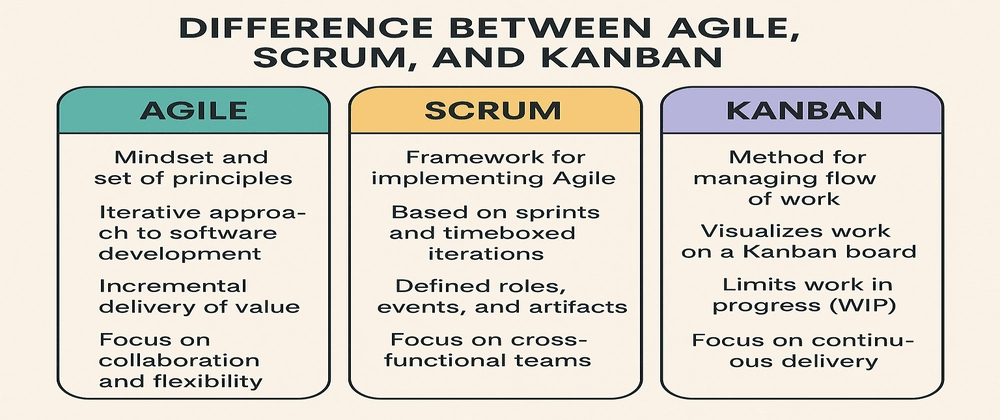
Agile is the philosophy. Scrum and Kanban are two popular ways to implement it.
Scrum (time-boxed approach)
-
Sprints: Short, fixed-length cycles (1–3 weeks).
-
Roles:
- Product Owner (sets priorities)
- Scrum Master (facilitates, removes blockers)
- Development Team (does the work)
-
Events: Sprint Planning, Daily Stand-ups, Sprint Review, Retrospective.
- Artifacts: Product Backlog, Sprint Backlog, Increment.
Scrum Example
A team promises: “In 2 weeks, we’ll deliver a baseline VM image.”
- They sync daily for 15 min.
- At sprint end, they demo the VM and get feedback: “please add curl and htop.”
- Next sprint, they adjust accordingly.
Kanban (flow-based approach)
- Visualize work on a board (To Do → In Progress → Done).
- Limit Work-In-Progress (WIP) to avoid multitasking chaos.
- Measure flow: cycle time (start to finish), throughput (items/week).
Kanban Example
An ops team gets requests: create users, patch servers, rotate keys.
- They allow only 3 tasks max “In Progress”.
- When one finishes, they pull the next.
→ Result: fewer half-done tasks, faster average completion.
Scrum vs Kanban (at a glance)
| Scrum | Kanban |
|---|---|
| Works in fixed sprints | Works in continuous flow |
| Team commits to a sprint goal | Team pulls tasks as capacity frees |
| Best for project-style work | Best for ongoing ops/support |