📘 Introduction to Public Cloud
Objectives
By the end of this chapter, you should be able to:
- Define what public cloud is and how it differs from private/hybrid models.
- Explain the key advantages and challenges of public cloud.
- Understand why organizations adopt public cloud for IT infrastructure and DevOps.
- Identify common use cases (where public cloud is a good fit, and where it’s not).
🌩️ What is Public Cloud?
A public cloud is a computing model where IT services (compute, storage, networking, AI, databases, etc.) are delivered over the internet by a third-party provider.
- The infrastructure (data centers, servers, storage) is owned and managed by the cloud provider.
- Customers rent or subscribe to resources on demand.
- Examples: Amazon Web Services (AWS), Microsoft Azure, Google Cloud Platform (GCP), Oracle Cloud Infrastructure (OCI).
👉 Think of it like electricity: instead of building your own power plant (private data center), you pay only for the electricity (compute/storage) you consume.
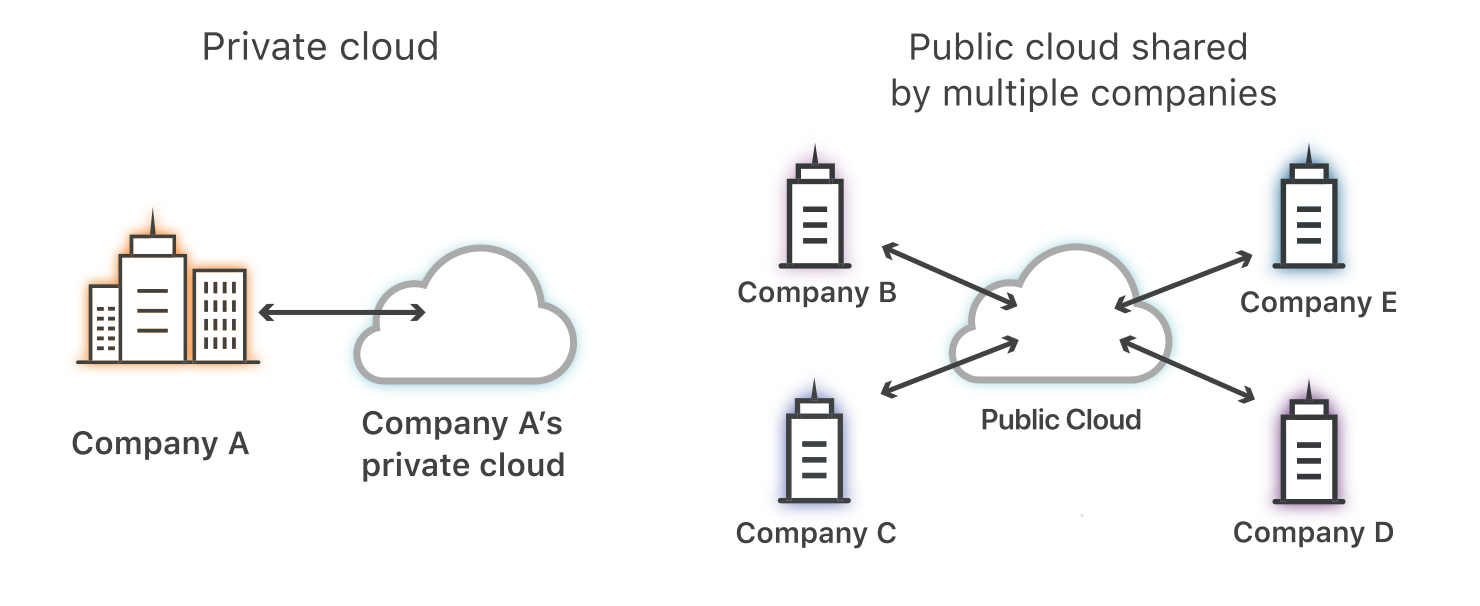
🏢 Public vs Private vs Hybrid Cloud
| Model | Who owns it? | Where does it run? | Typical Use Case |
|---|---|---|---|
| Public Cloud | Third-party providers (AWS, etc.) | Shared data centers | Startups, enterprises scaling quickly |
| Private Cloud | Single organization | On-premises or dedicated data center | Banks, defense, sensitive workloads |
| Hybrid Cloud | Mix of both | Combines private + public | Enterprises needing flexibility |
✅ Key Characteristics of Public Cloud
- On-Demand Self-Service – Provision servers or storage instantly.
- Broad Network Access – Services accessible from anywhere via the internet.
- Resource Pooling – Multi-tenancy (resources shared across many customers).
- Elasticity & Scalability – Scale up/down automatically with demand.
- Pay-as-You-Go Pricing – No upfront capital expense.
These characteristics align with NIST’s definition of cloud computing.
💡 Why Do Organizations Use Public Cloud?
Benefits:
- Cost Efficiency → No large upfront capex, pay only for usage.
- Speed & Agility → Launch new applications in minutes.
- Global Reach → Deploy apps close to customers in multiple regions.
- Innovation → Access to advanced services (AI, ML, IoT, big data).
- High Availability → Built-in redundancy across multiple zones.
Challenges:
- Data Security & Compliance → Sensitive data may need private cloud.
- Vendor Lock-in → Hard to move workloads between providers.
- Performance Variability → Dependent on internet and shared infra.
- Cost Overruns → If not managed, pay-as-you-go can become expensive.
🌍 Real-World Use Cases
-
Startups → Launch globally with zero upfront investment.
- Example: A fintech startup hosting mobile app backend on AWS Lambda + DynamoDB.
-
Enterprises → Migrate legacy workloads to reduce data center costs.
- Example: A bank using Azure for customer portals but keeping core banking on private cloud.
-
DevOps/IT Teams → Automate CI/CD pipelines in cloud environments.
- Example: GitHub Actions deploying code to GCP Kubernetes clusters.
-
Big Data & AI → Process petabytes of data using managed ML/AI services.
- Example: Netflix running recommendation engine on AWS.
🧭 Key Takeaway
The public cloud is now the default platform for modern IT and DevOps.
- It offers speed, scalability, and global access.
- It does not eliminate private or hybrid cloud but often complements them.
- As future DevOps/IT engineers, your skillset must include understanding public cloud services and APIs.
✨ Next Chapter:
We’ll explore “Services Provided by Public Clouds & Comparison of Top Providers” (AWS, Azure, GCP).