Software-Defined Networking (SDN)
What is SDN?
What is it?
Software-Defined Networking (SDN) is a modern approach to networking that separates the control plane (decision-making about where traffic goes) from the data plane (the actual movement of traffic). This allows networks to be programmatically managed through software rather than relying only on hardware (switches and routers).
In simple terms:
Traditional networking = manually configuring each switch/router.
SDN = central brain (controller) manages the whole network using software and APIs.
Theoretical Definition
According to the ONF (Open Networking Foundation):
SDN is an architectural approach that enables programmatic management, dynamic provisioning, and automation of networks by decoupling control and forwarding functions.
Key concept:
- Control Plane → Centralized in SDN controller (software).
- Data Plane → Distributed across physical devices (switches/routers).
- Northbound APIs → Connect applications to the controller.
- Southbound APIs → Connect controller to devices (e.g., OpenFlow).
SDN Architecture
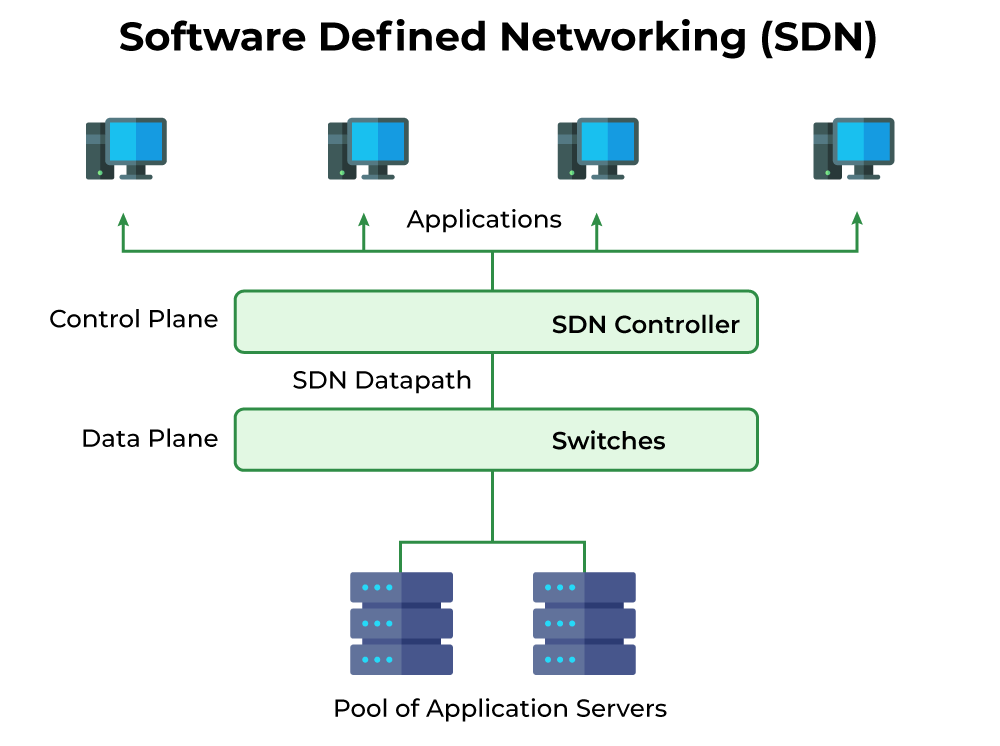
Layers:
-
Application Layer
- Business applications (firewall policies, load balancing, monitoring).
- Communicate with the controller using northbound APIs.
-
Control Layer (SDN Controller)
- Acts as the brain of SDN.
- Examples: OpenDaylight, ONOS, Cisco APIC.
- Provides a global view of the network.
-
Infrastructure Layer (Data Plane)
- Physical or virtual switches and routers.
- Forward packets based on controller instructions.
Key Benefits of SDN
- Centralized Control: One controller manages the whole network.
- Programmability: Network behavior is defined in software.
- Agility: Faster provisioning of services.
- Scalability: Manage thousands of devices with ease.
- Cost Savings: Uses commodity hardware, reduces vendor lock-in.
- Integration with Cloud: Works seamlessly with virtualization and OpenStack/Kubernetes.
SDN vs Traditional Networking
| Feature | Traditional Networking | Software-Defined Networking (SDN) |
|---|---|---|
| Control Plane | Distributed across each device | Centralized in SDN Controller |
| Data Plane | Same device as control plane | Remains in switches/routers |
| Configuration | Manual per device (CLI) | Automated via APIs |
| Agility | Slow, hardware-dependent | Fast, software-driven |
| Visibility | Limited to device-level | Global network view from controller |
| Cost | Proprietary, expensive hardware | Commodity hardware, open-source flexibility |
SDN Protocols
- OpenFlow → Most widely used, standard southbound protocol.
- NETCONF → Configuration protocol for network devices.
- REST APIs → Used for northbound communication with applications.
Leading SDN Vendors & Platforms
- Cisco ACI (Application Centric Infrastructure)
- VMware NSX
- OpenDaylight (open source)
- ONOS (Open Network Operating System)
- Nutanix Flow (security-focused SDN)
- Juniper Contrail
Real-World Use Cases
- Data Centers → Dynamic bandwidth allocation, tenant isolation.
- Cloud Environments → OpenStack Neutron integrates with SDN.
- Telecom Providers → 5G networks use SDN + NFV for slicing.
- Campus Networks → Simplified policy-based management.
- Security → Microsegmentation with VMware NSX.
Example Scenario
At TechOps Inc., the IT team deploys an SDN controller to manage 50 switches across two data centers.
- Instead of logging into each switch, they configure traffic policies in the SDN controller.
- When a new application is deployed in OpenStack, the SDN controller automatically provisions network paths.
- Security teams use SDN to isolate traffic between finance and HR applications (microsegmentation).
WoW Tip
Google uses SDN in its global B4 WAN (Wide Area Network) to manage inter-data center traffic. This allows Google to dynamically allocate bandwidth for services like YouTube, Gmail, and Google Search — improving performance and reducing costs.
Summary
- SDN separates control plane from data plane, enabling programmable, centralized network management.
- It provides agility, scalability, and integration with cloud-native environments.
- Core architecture: Application Layer → Controller → Infrastructure Layer.
- Widely used in data centers, telecom, cloud, and enterprise networks.