Data Center Ratings & Classifications
What is it?
Data centers are classified by tiers and standards to define their reliability, redundancy, and uptime guarantees.
These ratings help organizations decide what level of infrastructure they need based on cost vs reliability.
Theoretical Definition
The Uptime Institute Tier Classification and TIA-942 Standard are globally recognized frameworks:
- They measure availability, redundancy, and fault tolerance.
- Higher tiers = more resilient, but also more expensive.
Why is it Important?
- Businesses must match IT criticality with the right data center tier.
- Banks, healthcare, and cloud providers need higher tiers (near 100% uptime).
- Small companies may balance costs with lower tiers.
Classifications (Uptime Institute Tiers)
Tier I — Basic Capacity
- Definition: Non-redundant capacity components (single path for power/cooling).
- Uptime: 99.671% (~28.8 hours downtime/year).
- Use Case: Small businesses, test environments.
- Example: A startup hosting dev servers with minimal redundancy.
Tier II — Redundant Capacity
- Definition: Redundant components (N+1), but only one path for power/cooling.
- Uptime: 99.741% (~22 hours downtime/year).
- Use Case: SMEs needing some resilience.
- Example: Regional data center with backup UPS and generators.
Tier III — Concurrently Maintainable
- Definition: Multiple power/cooling paths; only one active at a time; components can be maintained without downtime.
- Uptime: 99.982% (~1.6 hours downtime/year).
- Use Case: Enterprises, banks, e-commerce.
- Example: Most colocation data centers.
Tier IV — Fault Tolerant
- Definition: Multiple active power/cooling paths; redundant systems (2N+1); can sustain one failure without downtime.
- Uptime: 99.995% (~26 minutes downtime/year).
- Use Case: Mission-critical (stock exchanges, global cloud).
- Example: Hyperscale providers (AWS, Google, Microsoft Azure).
TIA-942 Classification
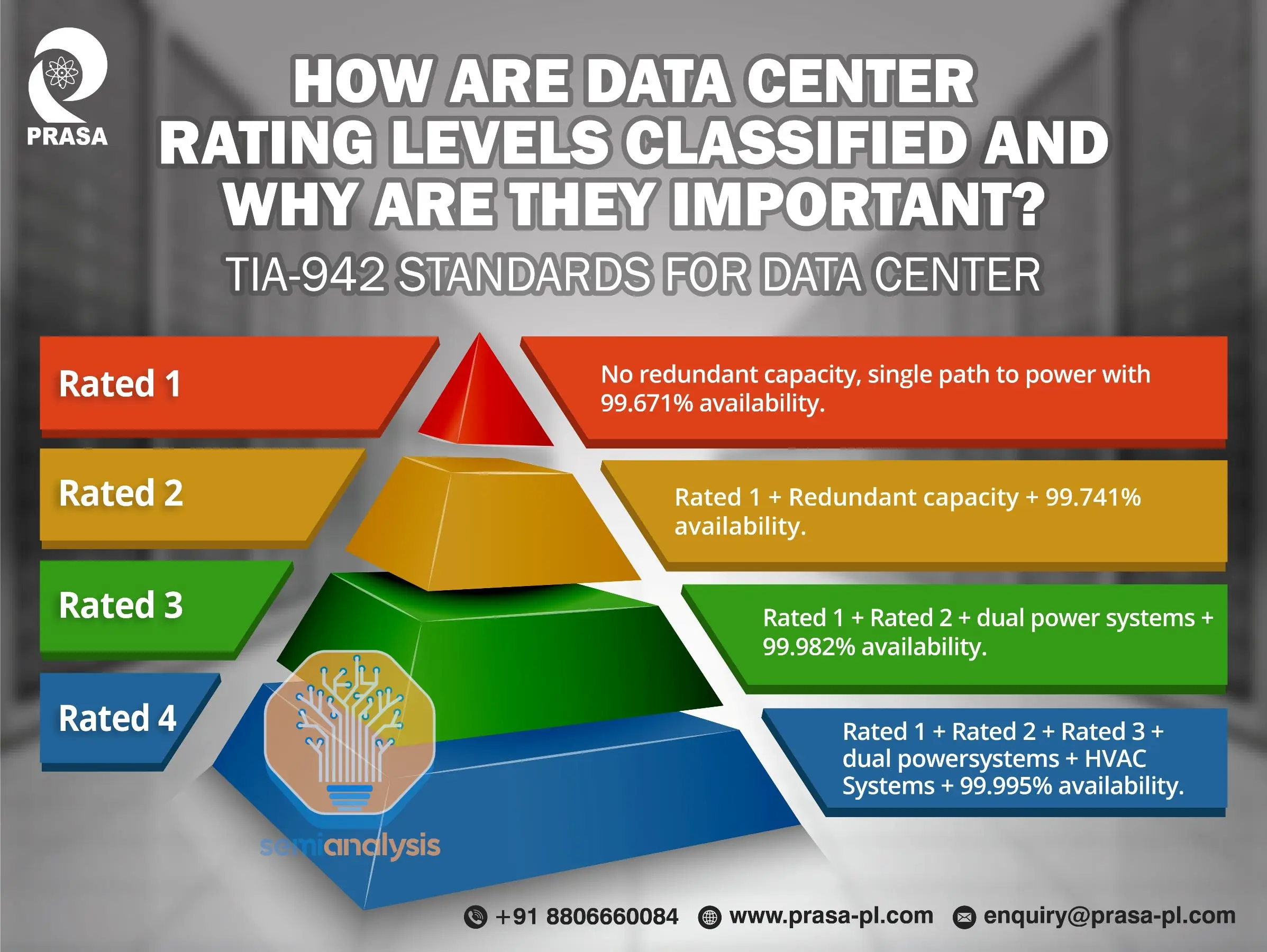
The Telecommunications Infrastructure Standard for Data Centers (TIA-942) defines four Rating levels (similar to Uptime Tiers).
It covers telecommunications, cabling, redundancy, and physical requirements.
- Rated 1: Basic site infrastructure, single path, non-redundant.
- Rated 2: Redundant capacity components, single path.
- Rated 3: Concurrently maintainable, multiple paths (one active).
- Rated 4: Fault tolerant, multiple active paths, fully redundant.
How is it Planned?
- Assess business needs (cost of downtime, compliance).
- Select tier/rating accordingly.
- Design with required redundancy levels (power, cooling, network).
- Certification by Uptime Institute or TIA-942 auditors.
How Can it Impact Down the Line?
- Lower tier = cheaper but higher downtime risk.
- Higher tier = resilient but higher CAPEX/OPEX.
- Wrong choice → either wasted money or business outages.
Real World Examples
- Tier I: Small office server rooms.
- Tier II: Local colocation providers in small cities.
- Tier III: Equinix, Digital Realty enterprise-grade facilities.
- Tier IV: Google, AWS, Microsoft Azure hyperscale facilities with global fault tolerance.
DC Ratings in nutshell
✅ Key Takeaways
- Data center ratings (Uptime Tiers & TIA-942) define availability, redundancy, and resilience.
- Businesses must align criticality vs cost when choosing a data center tier.
- Tier III is common for enterprises; Tier IV is essential for hyperscale and mission-critical industries.